
[Helsinki Lutheran Cathedral]
We visited Finland and Estonia in May into June of 2023, and while a few days does not make one an expert observer some things did stand out. The most obvious is the heightened anxiety in both countries about the intentions of their large and aggressive Russian neighbour after the invasion of Ukraine.
Pleasant and peaceful
Both countries are small and sparsely populated, although Estonia is much smaller than Finland in both area and population. Finland is about half the size of Manitoba in its surface area. Estonia is about three-quarters the size of Nova Scotia. Finland has a population of about six million and Estonia a mere 1.4 million.
The capital cities, Helsinki in Finland, and Tallinn in Estonia are pleasant and peaceful. They are easy to navigate, and everything works well. Each city contains much of the population in its country. Helsinki proper has a population of about 650 thousand and Tallinn about 450 thousand.
Both are port cities and barely out of sight from one another across the Gulf of Finland. The ferry crossing between them takes just two hours. Tallinn is older, dating back to the 13th century and it is one of the best-preserved medieval cities in Europe, a UNESCO World Heritage Site. Helsinki is more modern. It was founded by the overlord Swedes in the 16th century but was rebuilt by its new Russian masters in the 1800s after they took over from the Swedes.
The Russian city of St Petersburg lies at the eastern end of the Gulf of Finland, a 14-hour ferry ride from either Helsinki or Tallinn. Both Finland and Estonia also have land borders with Russia, and their proximity to a great power with an imperial tradition has been a major factor in their existence.
Walking tour
We usually begin a visit to a new city by taking a walking tour. They almost always focus upon the historic city centre and with the right guide you can learn something. In Helsinki, just steps away from the harbour, you encounter the spacious Senate Square dominated by four buildings designed in the early 1800s. They are the domed, and white Helsinki (Lutheran) Cathedral, the government palace, the main building of the University of Helsinki, and the National Library of Finland.
But the historical presence of the Russians is much in evidence. Senate Square is dominated by a monumental statue of Alexander II, the tsar (emperor) of Russia from 1855 until his assassination in 1881. He was also the Grand Duke of Finland.

Just a few blocks from the Lutheran church, the golden tipped domes of the Orthodox Uspenski Cathedral glitter in the sunlight, a reminder, if one were needed, about the lasting Russian influence in Finland. Our guide tells us that the Lutherans later added adornments to the top of their dome so that it would remain higher than those of Uspenski. The Lutheran religion is pervasive in Finland, counting about 65 per cent of the population, or 3.6 million people. The Orthodox church is much smaller, with about 50 thousand adherents, which represents about one per cent of the population.
About four per cent of Finns are Russian speakers, which compares to approximately five per cent whose mother tongue is Swedish. Finns of Swedish origin have guaranteed language rights. Swedish is one of two official languages, although many people also speak English.
Finnish history
Finns lived under the Kingdom of Sweden for 600 years, but the Russians invaded in 1808 and the country was formally ceded to Russia. Most Finns did not accept Russians as their masters, and after the First World War Finland was briefly independent. The Soviets invaded again in 1939 and the Finns put up stiff resistance. The war ended in a negotiated settlement with the Soviet Union annexing 10 per cent of Finnish territory.
When Hitler attacked the U.S.S.R. in 1941, Finns sided with the Germans, hoping to reclaim their lost territory. Although not formally an Axis member, Finland was aligned with Germany. It was a big mistake. After they repulsed the Germans in 1944, the Soviets attacked Finland again. Finland made peace, again ceding territory, and paying reparations. They retained their independence, and confronted by a belligerent neighbour Finland adopted a policy of military neutrality in the east-west competition for dominance.
The Finnish economy recovered well after the Second World War and the country joined the European Union in 1995. Finland is wealthy by almost any definition and consistently ranks near the top among nations when it comes to quality of life and wellbeing.
Finns join NATO
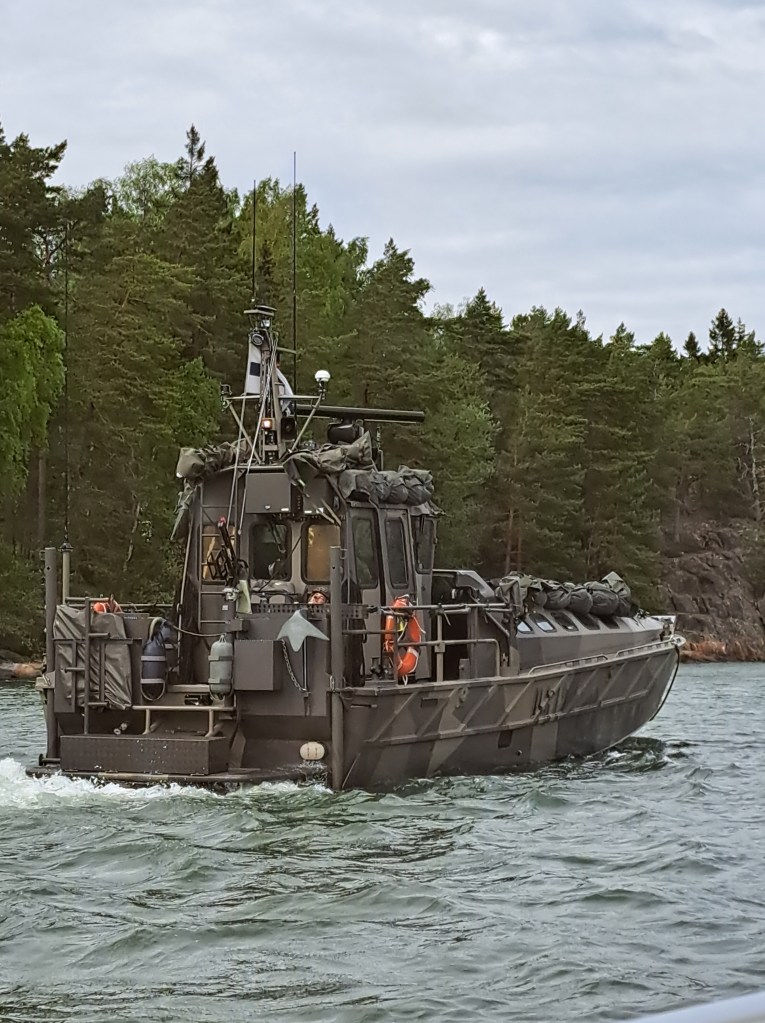
Finns were alarmed by the Russian invasion of Ukraine in 2022 and hastily jettisoned their neutrality to become members of the North Atlantic Treaty Organization (NATO) in 2023. Polls Indicated that move was supported overwhelmingly by citizens. Finland has a reserve army of 280 thousand, and military service of between six and 12 months is compulsory for all adult males. The Finns have a 1300-kilometre land border with Russia.
“We would prefer to remain neutral, but we need big friends,” a good friend in Finland told us. She and her husband took us on their boat to a rustic cabin they own on an island in the archipelago off the coast west of Helsinki. As we moved through a narrow passage, we encountered half a dozen amphibian troop carriers. Our friend told us that since the invasion of Ukraine, there are frequent military exercises in Finland’s coastal area.
Estonian history
Estonians, like the Finns, have spent much of their existence under the heel of empires: the Vikings, Danes, Swedes, and the Russians since the 1700s. Estonia gained independence briefly after the First World War, but the Soviets again occupied the country in 1940, as part of a secret deal under the Soviet-German non-aggression pact. Estonia was forcibly incorporated into the U.S.S.R.
In 1941, the Germans turned on the Soviets and invaded. In the process, they occupied the Baltic states, including Estonia. By 1944, the Nazis were driven from Russia, and the Soviets took over in Estonia once again. The economy was collectivized and integrated into that of the Soviet Union. Thousands of Estonians were sent to prison work camps in Siberia.
After the dissolution of the Soviet Union in 1991, Estonia proclaimed its independence and held elections. Along with the other Baltic states, it joined the European Union in 2004. Also in 2004, Estonia, along with seven other Baltic and Slavic countries, became members of NATO.
Estonian and Russian speakers
In the long years of domination, Russians were moved deliberately into Estonia. About 25 per cent of Estonia’s population now self-identify as ethnic Russians, with 90 thousand holding Russian citizenship. Many of them turn to Russian television for their news.
Estonian is the mother tongue of 67 per cent of the population, but 30 per cent have Russian as their mother tongue. Many people speak both languages, and the number of those who speak English is rising rapidly.
Dramatic tour
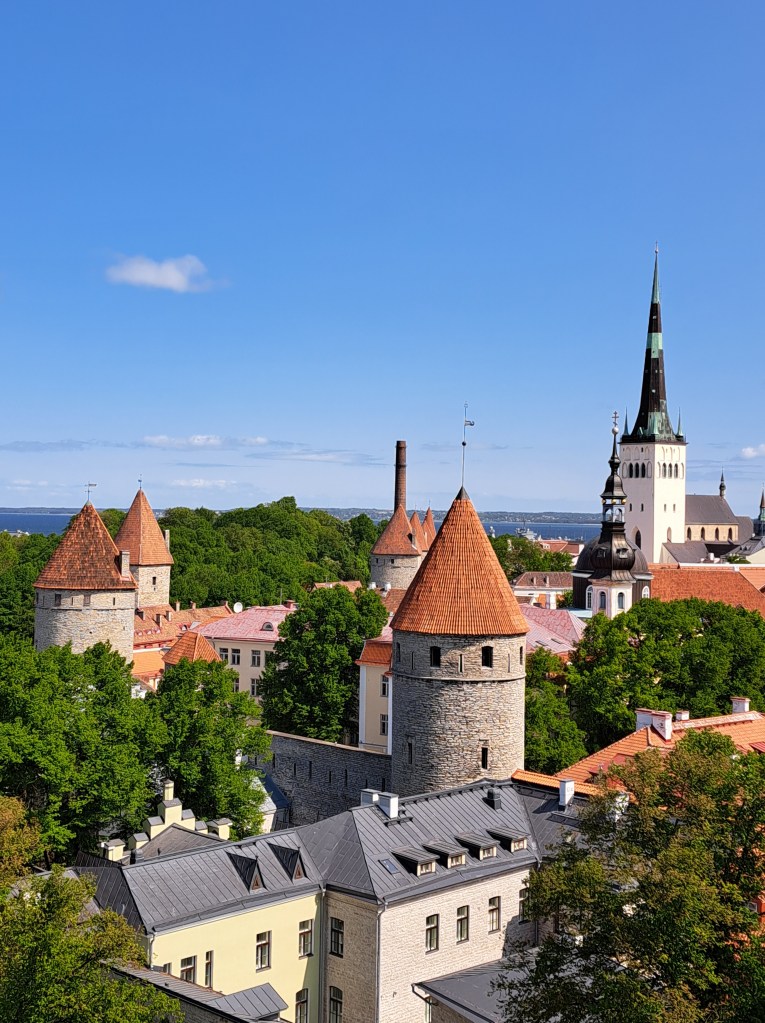
Our young guide on a city tour in Tallinn was forthright and dramatic. She took us to the old stone walls and to the upper town that looks down on a sea of red slate roofs. Her grandmother was one of the Estonians sent to Siberia after the Soviets took over following the Second World War. She survived but will not talk about the experience.
Our guide said there is little fraternizing between Russian and Estonian speakers, and inter-marriage is rare. Her parents were an exception. Her father is an Estonian speaker and her mother a Russian speaker. Since the war began in Ukraine, she said, her father has refused to speak Russian at all, although he is able to.
She said that the relationship between Estonian and Russian speakers is becoming more tense since the invasion of Ukraine. That has many consequences, she said, such as Russian speaking children being bullied at school, something of which she disapproves.
Religion in Estonia
Part of our walking tour included a brief visit to the St. Alexander Nevsky (Orthodox) Cathedral. Our guide said that we could go in, but that she would not. She did not say so, but her objection may have been specifically to the Estonian Orthodox Church, which operates under the jurisdiction of the Moscow Patriarchate of the Russian Orthodox Church. The local church waited for months to criticize the Russian invasion and did so under threats from the Estonian government.
Another possibility is that our guide was simply uninterested in religion. She told us that Estonians generally are not enthusiastic about churches. Indeed, we found that most of the churches in Tallinn were those of past overlords, whether Swedish or Russian. Today most church buildings serve other purposes, such as arts centres.
Our guide acknowledged that there was rampant corruption in government after the communist system gave way to largely unregulated capitalism in the 1990s, but by now the economy is doing reasonably well. Estonia, she said, is known for its proficiency in high-tech developments. For example, she said that software for Skype, the free video chat, messaging, and international calling technology, was created by three Estonians.
Estonia and NATO
Estonia has upwards of two thousand NATO troops, mostly British, within its borders. In May 2023, shortly before we visited, NATO forces numbering 14 thousand participated in military exercises called Spring Storm, testing their ability to rapidly deploy reinforcements in Estonia. The country shares a 300-kilometre land border with Russia.
Estonia’s female Prime Minister Kaja Kallas was quoted as saying: “We are under NATO’s umbrella, and that’s why we are living in peace, and Russia is not attacking us.”
Diplomatic row
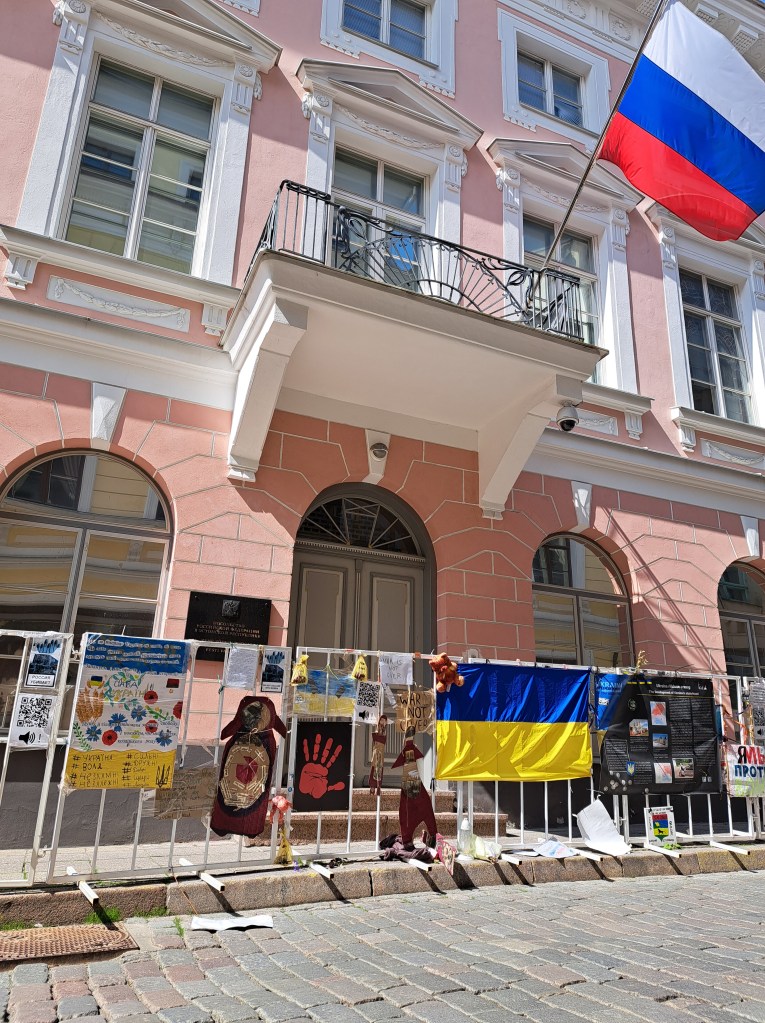
In January 2023, Russia accused Estonia of “Russophobia,” and expelled the ambassador. Estonia responded by asking the Russian ambassador to leave by the same date. In Tallinn, the vacated Russian embassy is near the city centre, and a fence on the sidewalk in front of the building is covered with graffiti accusing the Russians and their president of war crimes and telling him to get out of Ukraine. Every time we walked past the building, we encountered an Estonian police vehicle with officers inside and its motor idling.
When wars have ended
Helsinki and Tallinn are fine cities. We would gladly visit again, preferably at a time when wars have ended.
Note on sources
In addition to the links within the text above, I have used Encyclopedia Britannica for some basic fact checking on both Finland and Estonia. I took all of the photos that appear in this post.
Discover more from Pulpit and Politics
Subscribe to get the latest posts sent to your email.
 Pulpit and Politics
Thank you so much, Dennis! -most interesting. excellent photos too.
LikeLike
Wonderful blog, Dennis. It makes me want to go there but, alas, the reality is that my travelling days are over. I would also like to visit Latvia and i have many friends in Ottawa who are of Latvian origin.
LikeLike
Thanks so much Bob. Maybe you can’t travel to the Baltic but you can do a distant second best and have coffee with me. Let’s arrange it.
LikeLike
I’m concerned about the boosterism for NATO. NATO has zero to do with building a lasting peace. Frankly, it seems to be a proxy war on behalf of NATO– not that I support Russia, but history didn’t begin in 2023. I’m impressed with Lascaris’ travelogue and insights here:
LikeLike
Hi, and thanks. No boosterism here, but the Finns saw what happened in Ukraine and decided to join NATO. I think we should respect their intelligence in doing so.
LikeLike