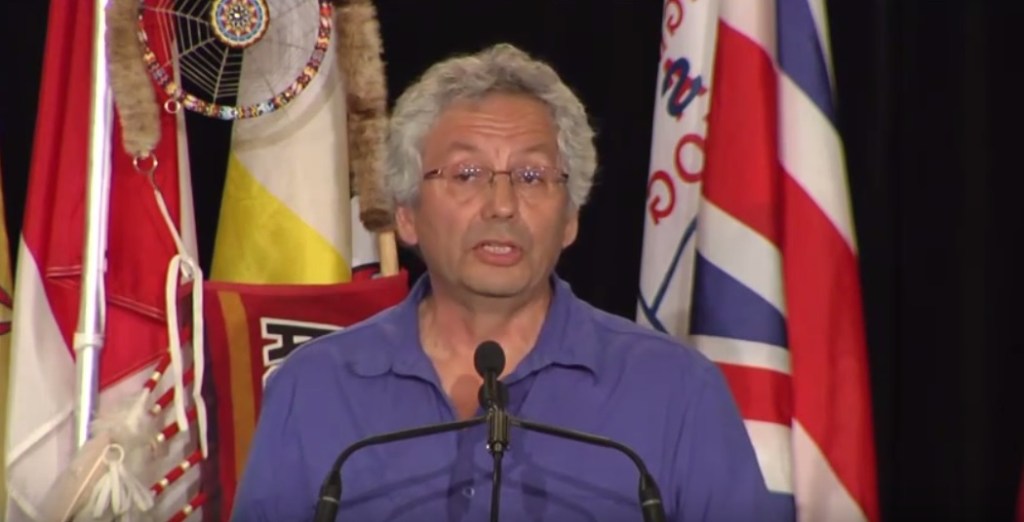
A CBC news team recently published a story about the RCMP’s widespread spying upon Indigenous leaders in Canada in the 1970s and 80s. A sub plot to the story is the frustration that the CBC journalists encountered in their year’s-long effort to obtain information from the RCMP Security Service files, which are housed at Library and Archives Canada (LAC). As I will show, this is a frustration with which I am only too familiar.
The RCMP believed that people like Dene leader George Erasmus (seen in the photo above), and George Manual, head of the National Indian Brotherhood, were extremists and potentially dangerous to society. In their spying, the RCMP employed a range of techniques, including direct surveillance, wire-tapping phones, and the use of paid informants, among people who were close to the leaders being surveilled.
Glacial pace on information requests
CBC journalist Brett Forester and his team began making Access to Information requests at Library and Archives Canada in 2022. They were told that before releasing any files, LAC would have to consult Canadian Security Intelligence Service. Someone at CSIS would then decide what is to be released, and what will be redacted.
There is legislation allowing for broadly-based exclusions concerning domestic and international security matters. The exclusions allow CSIS to withhold a lot of information, and to black out much of what they do release. That is so, even if the files are 50 or more years old, as is the case here.
LAC told Forester and his team that they would have to wait 1400 days just to find out if files would be released. That is almost four years. CBC appealed to the Office of the Information Commissioner, to no avail. The minister of Canadian Heritage then referred the matter to the federal court for a judicial review. Before the case could be decided, the government relented and the files were released, bit by bit.
My experience with Access requests
I have had an experience which mirrors that of the CBC journalists. In 2024, I published a book called A Communist for the RCMP. It is about a man named Frank Hadesbeck, now deceased, who was a long-time civilian informant for the RCMP Security Service. He infiltrated the Communist Party and provided information on them, and on many other, non-Communist progressives, for several decades between 1940 and 1976. He did this first in Calgary and later in Regina.
I first asked CSIS if they had files on Hadesbeck but they would neither confirm nor deny it, which likely means that the files do exist. I also made an Access to Information request to LAC, asking for any surveillance files the RCMP Security Service had created on William Beeching.
Beeching led the Communist Party in Saskatchewan for many years. Hadesbeck collaborated with him at the party office on an almost daily basis, then reported every detail to his Security Service handlers. I hoped that the file on Beeching would contain information which would help me to better describe how the RCMP conducted its surveillance.
Eight-year wait for information
I made my access request to the LAC on Beeching in February 2020, and it was confirmed on the following day. Over the following months and years, I made numerous follow up inquiries, which elicited a string of apologetic responses, but never any action.
I made a final inquiry early in 2024, just as I was finishing my manuscript. LAC told me that my request would take at least another 48 months to be completed. That meant a request that I made early in 2020 would, at best, be completed in 2028, eight years later.
I published my book without ever receiving valuable information that could have shed additional light upon how the Security Service spied upon many Canadians over the years.
I did not appeal to Information Commissioner or prepare a court case. I am an independent researcher and writer, not a member of a team backed by corporate resources such as the CBC can provide. I had a publishing deadline and had to concentrate on writing rather than litigating.
A common frustration
My frustration is common to anyone attempting to use Access to Information. The system which is supposed to provide Canadians with information about the activities of their government is broken, and we are all the poorer for it.
During the election campaign in 2015, Justin Trudeau promised improvements, if elected. That promise was not kept. There have been three elections since, and in the most recent campaign Mark Carney also promised action. We shall see.
Improving Access to Information
Ottawa could improve the system by establishing a declassification framework which is separate from the Access to Information Act. Experts appointed to the task would identify entire categories of historical documents which can be readily made available to the public. That would avoid the time-consuming and hair-splitting exercise of having to send requests back to the originating agencies for slow review and redaction.
A problem for historical researchers is that requests about what might have happened 50 or more years ago are treated with the same caution as a request about recent events. The government should automatically declassify any document that is more than 50 years old. No exceptions. There is no legitimate justification, based on either personal privacy or national security, to withhold information about what governments and their agencies did long ago.
Stop blocking the door
No doubt there are cases more urgent than mine. They might relate, for example, to corruption in the choice of government contractors, or the historical theft of Indigenous treaty land by well-connected people. But the principle is the same. As citizens, we have a right to know what was done in our name, and governments must stop blocking the door.
Discover more from Pulpit and Politics
Subscribe to get the latest posts sent to your email.
 Pulpit and Politics
Leave a comment