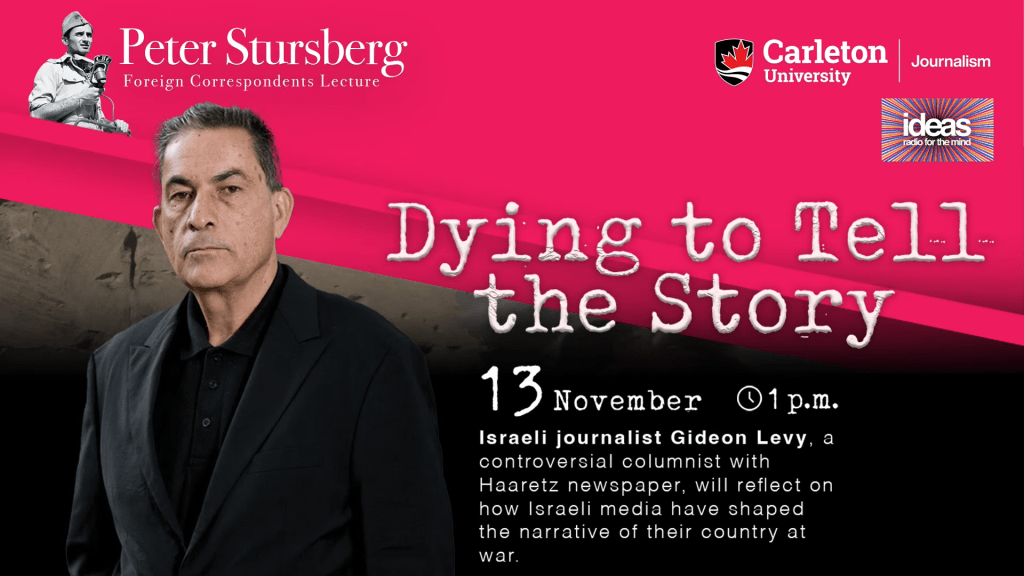
Gideon Levy is someone whose journalism I have admired at a distance for years. He is a columnist for the Israeli newspaper Haaertz and a fierce critic of his country’s media.
On November 13, speaking online from Tel Aviv, Levy delivered the annual Peter Stursberg Foreign Correspondents Lecture, sponsored by the School of Journalism and Communication at Carleton University.
On the previous day, Shrouq Al Ailia, a young Palestinian journalist, spoke from Gaza. This is the first time that the Stursberg lecture has taken the form of a two-part series. The intent was to examine the gravity of the role of journalism during the Israel-Gaza war. The two-part series was titled Dying to Tell the Story.
Nahlah Ayed, host of CBC Radio’s Ideas program, moderated the events and interviewed both Shrouq Al Aila and Gideon Levy. The lectures and interviews will be edited and broadcast by the Ideas program. I posted earlier about Al Aila’s appearance. After his remarks, Levy responded to questions from Ayed, and questions from the audience relayed by Ayed. What follows here are excerpts drawn from my written notes.
The lecture
People think that I am an expert on Palestine. Not at all. I don’t even speak the language. But for the past 36 years I have covered the Israeli occupation. I tell Israelis what is being done on their behalf in an occupation that is 53 years old and shows no sign of ending. I like to say that without the collaboration of the Israeli media the occupation would not have lasted so long. They hid the occupation from the public. It is unforgiveable. History will judge the Israel media harshly.
October 7th
After October 7, the media brings only one voice to the table. The studios are exploding with experts and commentators, but no contesting voice is heard. In the past year, I have been called upon twice by Israeli media, but I am on CNN and other outlets all the time. Friends [in Israel] tell me they cannot have me on as a liberal voice. They have only one voice. It is a game, not journalism. It is a betrayal of our profession.
They cover October 7 on a daily basis, again and again. If you open newspaper or watch TV, you will see only Israeli victims, the Israeli hostages, the funerals of Israeli soldiers, the displacement of Israeli citizens from shelling. This is the entire context. The Israeli media is telling the story of ourselves. There is only one side.
Nabka and occupation
During the decades of the occupation, when Palestinians were covered, they were dehumanized. And that is the spirit of the time, not to present the Palestinians as human beings, not to tell their narrative, their tragedy. That tragedy began with the Nabka [1947-48]. I did not hear that word until I was 20 or 25 years old. I did not hear about it. All kinds of lies were told to us.
The occupation that began in 1967 was even worse. The media takes the side of dehumanizing the Palestinians. Israelis are people no better or worse than in any other society. I can’t believe the average Israeli would agree if they knew about what we have been doing for many years. There is a black hole in coverage of the Palestinians. In other cases, the Israeli media can be quite courageous, but regarding the Palestinians they say [to the government and the army], “We know what you want from us. We will not bother you too much when you say we have the most moral army in the world.”
The occupation is brutal, but you do not get the story in the Israeli media. There are thousands of Palestinians who are detained in Israeli jails without trial. The media will not call it detention without trial. They call it “administrative detention.” They accept all the language of the army to make it easier to accept the horror of the occupation.
Fulfilling our duty
Journalism is not just a business that has to make money. We have a role to play, and we cannot betray it in a democracy. One day people will ask about these dark days, “Where have you been? Why did you not tell us the whole story?” I and my newspaper are trying to fulfill our duty, our professional commitment. This is an important role.
There are those who think Israel has too much democracy. A woman told me that we have too much democracy here and that I should be in jail. Most Israelis believe that after October 7, Israel has the right to do whatever it wants. They think all Palestinians are rapists and murderers. They do not want to hear of the pain and suffering of Palestinians. When the UN General Secretary talked about it, they called him an anti-Semite.
The interview
Nahlah Ayed: You say the Israeli media willingly self-censors. You don’t, so how do you get published.
Gideon Levy: I am privileged to be Jewish in a Jewish state, and to have Haaertz as a platform. I don’t how long it will last. They [Israeli government] closed Al-Jazeera and they may close us. Meanwhile I can express myself in total freedom, the last of the liberal democrats.
Nahlah Ayed: How are you different from other journalists.
GL: In 1988, I decided to cover the occupation. At least once a week I go to the occupied territory. Over time I changed my views because I saw what was happening with my own eyes. Not many journalists did this journey. I go to know the victims, not the politicians. The Palestinians want peace much more than the Israelis do, but they want to live in dignity.
Nahlah Ayed: Bearing witness is becoming more difficult now. How frustrating is this for you?
GL: It’s very frustrating. I am read more in English than in Hebrew. Within Israel, they don’t read it. They are angry. They are not open to hearing it.
Audience question via Nahleh Ayed: You mention that there is an advantage in being a Jewish journalist. What is the advantage.
GL: There are two kinds of Palestinians. In the West Bank, they are under occupation. Within Israel, 20 per cent of the population is Palestinian. Formally they are equal citizens, but in the past year they are afraid to say anything. The police are at your door. You might be arrested. But I am in a state based on Jewish supremacy. I am part of the supremacy.
Audience: How do you follow the news in Gaza.
GL: It’s one hour and fifteen minutes from my home, but I can’t go there. People don’t want to know. Al Jazeera was there [but have had to leave]. Is it comfortable for our citizens to open Al-Jazeera and see the bodies? So, they don’t want to know or to hear about it because then you face a dissonance.
Audience: Are Haaertz or you at risk?
GL: There have been concrete threats. I have had bodyguards in the past, but I do not think that I am at risk. I am not the story. Haaertz is at risk. I think some Israeli politicians want to close us down. What happened to Al Jazeera could happen to us. It is suggested that we should have legislation making it illegal to criticize the army.
Audience: What has to happen for this to change.
GL: The younger generation is much more nationalistic and right wing than others. It comes with an ignorance of what is happening. Here, I am not optimistic. I am more optimistic about the international community, but given the result of the US election we will have to wait for another four years.
Nahled Ayed: How does the Western media cover the situation. What do they miss.
GL: The western media is doing a much better job than the Israeli media. Al Jazeera does a good job. But Israel labels any criticism as anti-Semitism. There is anti-Semitism, but most people who criticize the Israeli government are not anti-Semitic. How could you not be critical when you see 20,000 women and children killed?
Available on YouTube
Gideon Levy’s lecture and the interview which followed are available to be seen on YouTube.
Discover more from Pulpit and Politics
Subscribe to get the latest posts sent to your email.
 Pulpit and Politics
Thanks very much Dennis. I look forward to hearing Ayed’s program, or has it already been broadcast? She is an excellent commentator but I feat that her sort of program is one that Polievier would like to get rid if and is a good reason why we need the CBC. Am reading your book and will comment later. Cheers Bob N
LikeLike
Thanks Bob, always good to hear from you. The Ideas program will take some time to assemble and I don’t know when they plan to run it. But at the end of each of my pieces on the Stursberg lectures there are YouTube links to the talks given by Levy and Al Ailia.
LikeLike