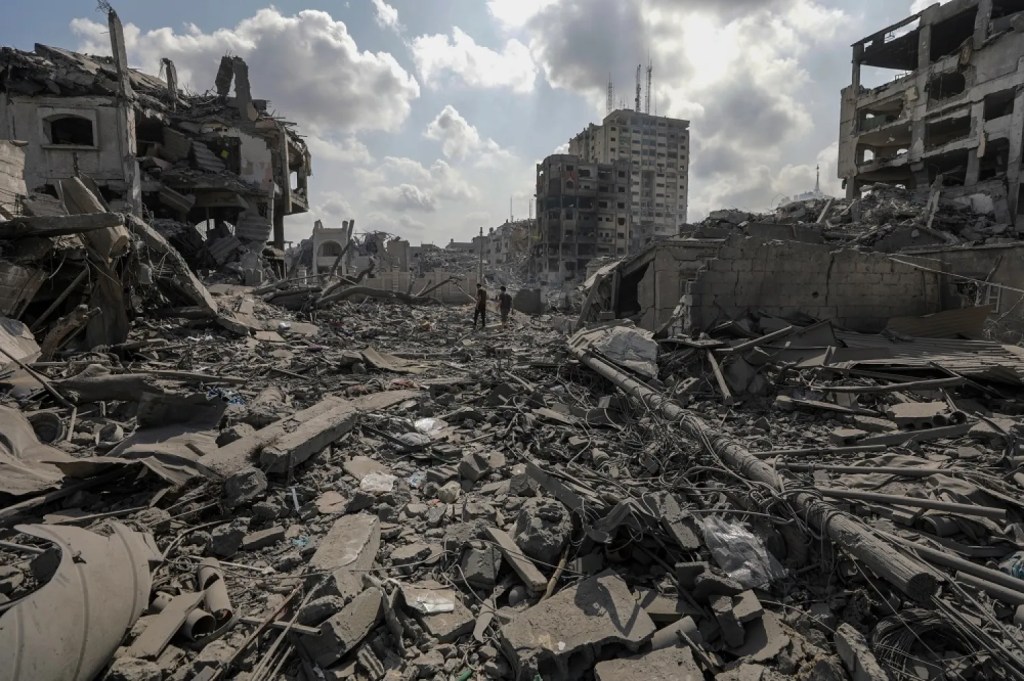
The anniversary of a deadly attack by Hamas militants on Israel on October 7, 2023, has come and gone. The prevailing narrative in our media is that Israel was attacked by terrorists and has a right to defend itself, no matter the cost in Palestinian lives and destruction, as illustrated in the photo above from Gaza. There is a resistance to admitting that prior to October 7 Palestinians had endured seventy-five years of displacement, death, and humiliation at the hands of the Israelis.
On October 3, the Globe and Mail newspaper published a lengthy article written by Yossi Klein Halevi, a senior fellow at the Shalom Hartman Institute in Jerusalem. He focused almost entirely on the October 7 event. He used the word “massacre” six times, “ terrorist” seven times, “horror” three times, “murder” three times, and “atrocities” twice.
Halevi’s description of Israel as the innocent victim of Palestinian aggression is common, but also inaccurate. Israel is a military a superpower with nuclear weapons, a large army, a deadly security apparatus, and a modern arsenal, most of it provided by the United States.
Halevi described Israel’s creation in 1948 as the fulfillment of a long-held dream — “that a dispersed and powerless people would somehow reclaim its ancient homeland.”
Rashid Khalidi

It takes a brief trip through history to refute the homeland argument. I use as my main resource a book called The Hundred Years War on Palestine: A History of Settler Colonialism and Resistance, 1917-2017. It was written by Rashid Khalidi, an American of Palestinian descent, who until recently taught at Columbia University in New York City. His book is a New York Times bestseller.
Khalidi belongs to a prominent family in Palestine going back to a time when it was part of Ottoman Empire. His great-great-uncle Yusuf Diya al-Khalidi was the mayor of Jerusalem in the 1890s, and he also taught for a time at the Royal Imperial University in Vienna.
Zionism
It was in Vienna in 1896 that an Austrian named Theodor Herzl published a book called The Jewish State. In it, he argued that the assimilation of Jews into European society was impossible and that the only solution was the creation of a specifically Jewish state, preferably in Palestine, which Herzl considered the homeland of the Jews. Herzl’s book was followed in 1896 by the establishment of the Zionist World Congress, and Herzl became its president.
In his private diary in 1895, Herzl was explicit about his plan. Khalidi quotes Herzl from that diary entry: “We shall try to spirit the penniless population across the border by procuring full employment for it in the transit countries, while denying it employment in our own country . . . Both the process of expropriation and the removal of the poor must be carried out discreetly and circumspectly.”
On March 1, 1899, Yusuf al-Khalidi sent a seven-page letter to Herzl warning him against the Zionist project. “Palestine is an integral part of the Ottoman Empire,” he wrote, “and more gravely, it is inhabited by others.” It would be “pure folly,” he said, for Zionism to take over Palestine.
The obvious complication, as Herzl tacitly admitted in his diary, was that Palestine was already home to a well-established population, most of them Arabs. Many families had lived in the region for centuries. An 1882 census in the region showed that only about five per cent of the 470,000 inhabitants were Jewish.
The Zionist immigration project was modest at first, but it gathered steam. By 1914,Jews represented ten per cent of the population. The settlers were assisted by capital from abroad to purchase land from absentee landlords and create agricultural colonies.
Balfour Declaration
Great Britain was the preeminent colonial power of the day. In 1917, the British foreign minister, Lord James Balfour, declared that his government would “view with favour the establishment in Palestine of a national home for the Jewish people.” Balfour did not bother to mention Palestinians, referring to them simply as members of “non-Jewish communities” in Palestine. Balfour’s declaration followed intense and successful lobbying by influential Jewish citizens in Britain.
In 1922, the League of Nations created Mandate Palestine, placing Great Britain in charge of establishing the Jewish national home. Palestinians began to organize against the plan and there were riots during the 1920s, and again between 1936 and 1939. The British responded with martial law and a massive use of force.
The trickle of Jewish immigration grew rapidly after Hitler came to power in Germany in 1933. By 1939, thirty per cent of Palestine’s population was Jewish. Many were skilled and educated. The Jewish sector of the economy soon overtook that of the Arabs.
The Palestinian uprisings convinced Britain to reconsider. It proposed slowing down Jewish immigration and creating an independent Palestinian state in addition to that of Israel. That drew a violent response from Jewish paramilitary groups such as Irgun and the Stern Gang, which had become established in Palestine. In 1944, they murdered Britain’s chief diplomat in Egypt, and in 1946, they blew up the British headquarters Jerusalem’s King David Hotel, killing ninety-one people.
Menachem Begin and Yitzak Shamir were among the leaders of those paramilitary groups. Both were later to become Israeli prime ministers. Halevi does not mention them in his article. One wonders if he would acknowledge them as terrorists, and their organizations as terrorist, a description that he attributes to Hamas and Hezbollah in Lebanon.
Partition and war
Britain’s international influence was shrinking, and it was shocked by the terrorist attacks upon its diplomats and staff. In1947, Britain handed the task of arranging the future of Palestine to the newly created United Nations. The US had replaced Britain as the world’s great power, and the Jewish lobby in the US was sophisticated. Their case was strengthened by the genocidal persecution that Jews suffered at the hands of the Nazis during the Second World War. Under pressure from the American government, the UN recommended in November 1947 that Palestine be partitioned into a larger Jewish state and a smaller Arab one.
There were 1.3 million Arabs living in Palestine and 600,000 Jews, most of them recent arrivals from Europe. The proposed Jewish state was to receive fifty-six per cent of the land area even though Jews represented only thirty-one per cent of the population. Fighting broke out almost immediately after the November 1947 proposal, and it continued for months up to and beyond May 1948. In that month, Israel unilaterally declared its statehood, even before details of the UN partition was worked out.
The Nakba

An estimated 700,000 Palestinians were driven from their homes and lands in the territory that became the state of Israel. The displacement was, and is, known in Arabic as the Nakba, or “the catastrophe.” It was conducted ruthlessly by Israel’s nascent army and the Irgun and Stern Gang para-military groups.
There was another war in 1967 in which Israel annexed East Jerusalem, conquered Gaza, the Sinai Peninsula, the West Bank of the Jordan River, and seized the Golan Heights from Syria. Israel later withdrew from Gaza but subjected it to a punishing blockade. Its military occupation of the West Bank and the Golan Heights continues today, fifty-eight years later. During these five decades, Israel has relentlessly pushed Jewish settlements into the remaining Palestinian lands.
Solutions elusive
It is difficult to see where solutions lie in this long conflict. A common proposal by diplomats, including those in Canada, is for a two-state solution, which means a sovereign state in Palestine adjacent to that of Israel based upon pre-1967 boundaries. But Israel’s prime minister Benjamin Netanyahu has flatly refused to countenance a Palestinian state.
Haveli, in his article, expressed alarm at a slogan used at pro-Palestinian demonstrations in North America. The chant is, “From the [Jordan] river to the sea, Palestine will be free.” Haveli sees that as an existential threat to obliterate Israel and its people. Whatever their intentions, demonstrators have little ability to affect solutions.
Ethnic cleansing
Prime Minister Netanyahu does have such ability, and he has used it. As war rages in Gaza, and now in Lebanon, settler violence and land grabs have increased markedly in the West Bank. Netanyahu not only allows it, but senior members of his cabinet promote it. There is even talk among them about occupying all of Palestine, including Gaza, and deporting its inhabitants to neighbouring countries. That would fulfill Herzl’s wish as stated in his diary entry 130 years ago.
The effective threat of ethnic cleansing comes not from street demonstrators, but rather from the Israeli government.
Discover more from Pulpit and Politics
Subscribe to get the latest posts sent to your email.
 Pulpit and Politics
Thank-you Dennis. This is a very good summary. Khalidi’s book is, in my view, required reading for anyone who seriously wants to understand what has happening and continues to happen in Palestine. Lawrence
LikeLike
Thanks Lawrence for your comment. Obviously you have read Khalidi as well.
LikeLike
Three comments Dennis. First while it is certainly the case that there was significant European Jewish immigration into Palestine in the 1930s, there was also Arab immigration into the area. The data I have looked at suggests about equal numbers during that period. Second it was the opposition from the front line states that prompted the war to eliminate the nascent Israel. It was in the context of that war that many Palestinians either left or were driven out. Third, about an equal number of Jews from the surrounding states were driven out of their homelands as the conflict unfolded and after it was over in 1948. They had lived in those countries for many centuries. Many went to Israel as a refuge. There are many more comments I could add about the history. However it is my view that the conflict will only end when the Palestinians and Israelis can come to an agreement about how to live together. There is no military solution.
LikeLike
Thanks Allan. Agreed. There is no military solution.
LikeLike
Good write-up, Dennis. On your recommendation I have read Khalidi’s book, which I also found very good. From reading this book and some other articles, I conclude that the only solution to this problem will come when both sides really want a solution and are able to learn to look at the situation with a total understanding of the other side. This is impossible under present leadership. Entirely new leadership would be required. I’m not too hopeful of that happening, unfortunately. Ellen
Shenk
LikeLike
Thanks, Ellen, for the note. all conflicts end eventually, although the one between Israel and the Palestinians has been going on for a long time. Historically, the origin of the problem is that the Palestinians were evicted, gradually, and then violently in 1947 and years following.
LikeLike
Thank you, Dennis, for the very clear and concise history and the current situation between Israel and what could be, should be, Palestine.
The terminology of “ ethnic cleansing “ rings true. Absolutely. It will leave a stain on the people of Israel. And recently, Biden gave a billion or so to Israel to carry on this unconscionable genocide.
War crimes.
It leaves me sad.
Keep writing.
LikeLike
Thanks for your comment Marlene. I double checked. On his way out the door, President Biden has sent $8 billion in military aid to Israel. There is no way the US can act as an honest broker for peace in the region.
LikeLike