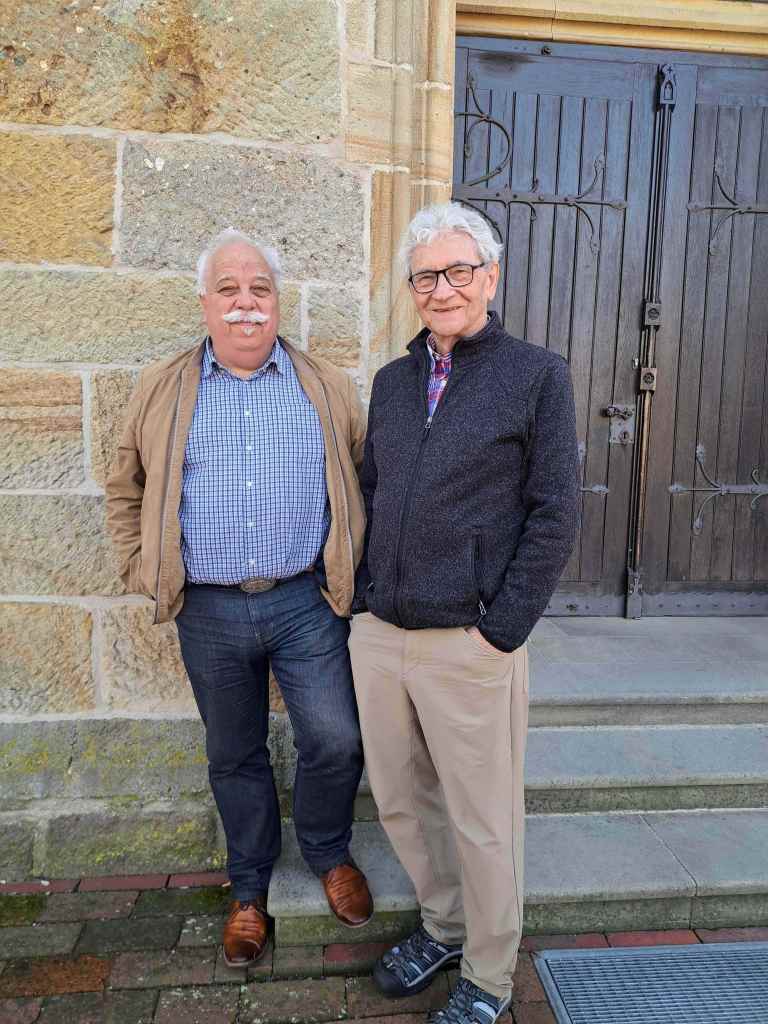
My wife Martha and I traveled recently in Germany, where I sought out Gruending family roots. We were guided by Franz-Josef Tegenkamp. He is not family, but rather someone who has relatives in Bruno, Saskatchewan, a town not far from where I was raised.
Franz-Josef works in an auto parts plant, but his real passion is genealogy and he is a skilled researcher. He also has an impressive handle bar mustache. He was able to find our family name in church records dating back to 1449. That is a half century before Columbus set sail from Spain to the new world.
Fifteenth century church records
In 1465, the records show that a man named Grundick was half owner of a farm that had been sub-divided by the local noble. In that year, Grundick had to pay him a cattle tax of two Schillings and four Pfennigs. Incredibly, the farm, as I will explain later, is still in the extended family.
In Germany, spelling of the family name has evolved over the years to Gründing. In Canada, it is Gruending.
Gründings in Lower Saxony
The Gründings lived near a small town called Neuenkirchen in Lower Saxony. That is in northwestern Germany, bordered by the North Sea and the Netherlands. The topography is low lying and flat. It is agricultural, with tractors in the fields and on the roads. In recent decades the area has also become home to light industry, including the production of various plastics.
In the early 1800s, my great-great grandfather had to leave the farm, which was inherited by a younger brother as was the custom. My ancestor became an innkeeper. His son, my great- grandfather, Gerhard Anton was born in 1847 and baptized in the church at Neuenkirchen. He was a landless farm worker.
Gerhard Anton married Catharina Macke in 1872. They had four children, including my grandfather, Johann Heinrich, who was born in 1877. Tragedy struck the family in the following year.
A violent death
It has been family lore than Gerhard Anton was killed by another man in his community, and it turns out that he was. Franz-Josef, the enthusiastic genealogist who showed us around, was able to assemble the facts.
He used church records to establish that Gerhard Anton died on November 6, 1878. The cause was listed as a brain injury, but the record provided no other details. Franz-Josef then discovered a newspaper report describing a violent incident, without naming either the victim or the attacker.
The newspaper said that the victim had a fight at a wedding with a man who was an apprentice blacksmith. Later, as the victim made his way home, the apprentice lay in wait and struck him on the head with a manure fork. The victim lost consciousness and died within twenty-four hours at age thirty-one. The assailant fled. He was not identified in the newspaper story.
My grandfather, Johann Heinrich, was just twenty-two months old when his father died. There were two older sisters, and at the time of the killing Catharina was pregnant with another daughter who would die in infancy.
Emigration to the United States
Catharina remained a widow for the next fourteen years. Many Germans from her community had emigrated to the United States, including some of her siblings.
In 1892, she followed them, but in a novel way. In what must have been an arranged marriage, a widower and German emigrant named Ferdinand Vornbrok returned from Minnesota to accompany Catharina and her three children to the United States.
In March 1892, Catharina and Vornbrok were married by a priest on their passenger ship, The Elbe. Days later, they disembarked in New York City and traveled to Stearns County, Minnesota, north and west of Minneapolis. In December, Catharina, who was forty-one years old, bore a son.
Catharina died a scant four months later, in March 1893 at age forty-two. Relatives in Minnesota believe that she was ill throughout the voyage at sea. Then in August her young son, John Bernard, died at eight months, likely from cholera. Those were not easy times
Moving to Saskatchewan
My grandfather apparently did not like his stepfather. At age fifteen he was on his own. A Minnesota census taken in 1900, when he was twenty-three years old, showed him working for a family as a “servant.” Most likely he was a landless farm worker.
In 1902, he married my grandmother, Mary Peters. She was born into a large family near Münster in Westphalia in 1878. Her parents, too, were landless farm workers. In 1884, they emigrated to Minnesota but remained landless there as well. The homestead land was all taken up, and they could not afford to buy.
In1903, the Peters family emigrated once again, this time to the Humboldt area in what is now Saskatchewan. My grandmother’s father Theodor was sixty-four years old at the time of this last move. My newlywed grandparents followed in 1904. They and many other Germans from Minnesota made their new lives in Saskatchewan.
Farm in Germany
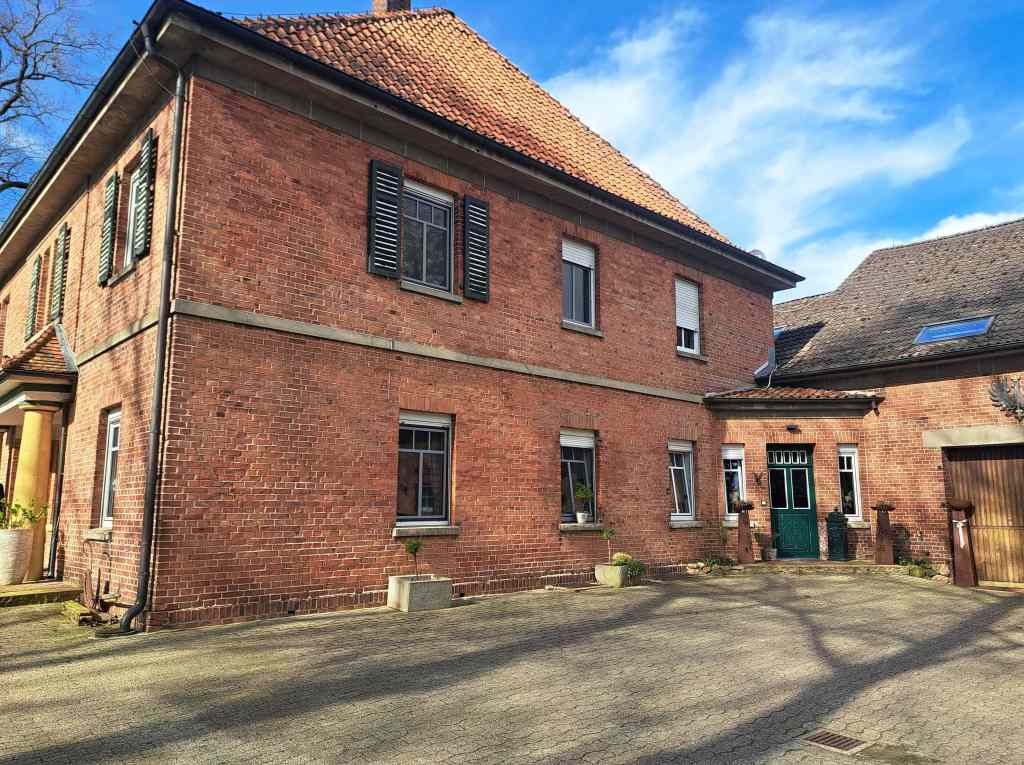
Back in Germany the Gründing farm has remained in the family for more than five hundred years. That has been possible mainly because various men, who entered the family through marriage, agreed to change their surnames to Gründing.
Although we had never met the farm’s occupants, Franz-Josef arranged a visit and they were gracious hosts. The farm is now operated by a young man named Christof. His mother, Maria Theresia (nee Gründing) took the name Fereding, which belonged to her husband. But her father’s dying wish was that his grandson take over the farm and assume the Gründing name, which he has done.
The farm includes various out buildings and a solid brick house built in 1925. It is attached to a barn. The farm contains sixty-three hectares and Christof uses it to raise purebred horses for equestrianism and dressage. He also has two large chicken barns. He hires help and continues to operate a separate business, recruiting workers for local farms and businesses.
It was inconceivable to me that someone would change his name to inherit a farm. But Christof said he felt when he committed himself to the farm that he should also assume the family name as a sign of that commitment.
Lives wasted in war
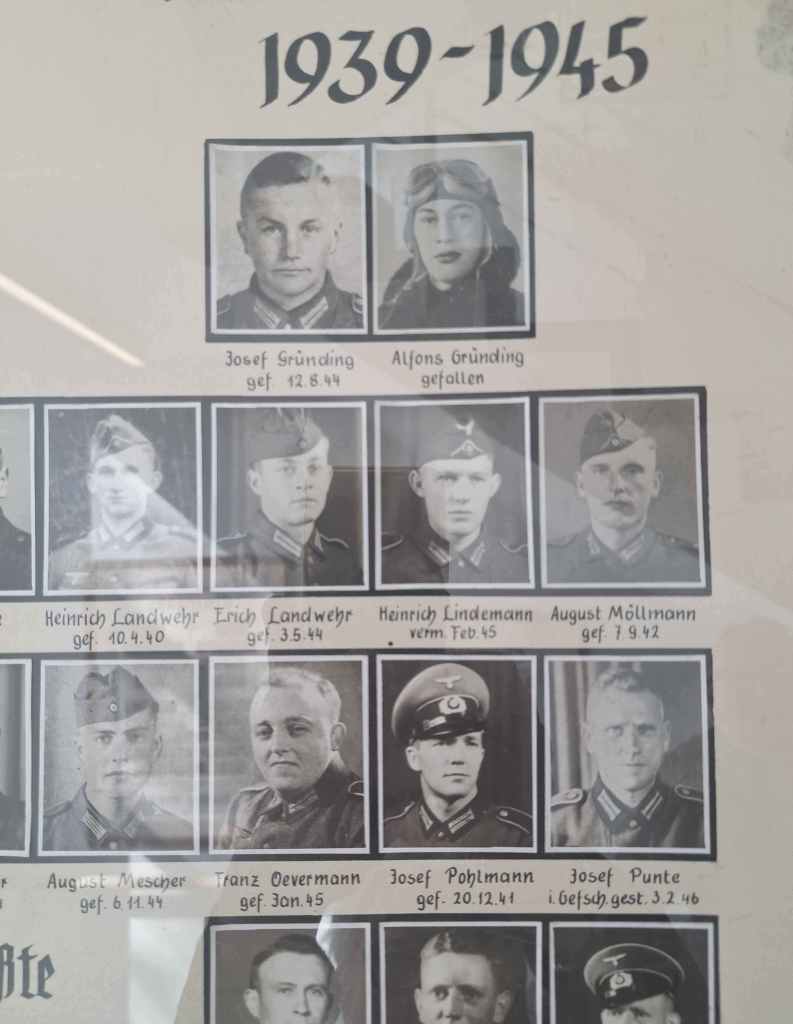
As I stood with Christof in the farmyard, I thought of a photo display that I had seen the previous day in Neunkirchen’s town hall. The walls of a stairwell featured several large frames containing the photos and names of locals who had died in the First and Second World Wars.
Five of those young men were Gründings. In Canada, my uncle Hugo Gruending was drafted into an army fighting against his distant and unknown relatives in Germany. Their lives were wasted in war. He was spared.
Discover more from Pulpit and Politics
Subscribe to get the latest posts sent to your email.


Leave a Reply