I wrote in a previous blog post that we traveled recently in Germany to see where my paternal grandfather and great-grandfather were born, christened, and raised. They lived near a small town in Lower Saxony bordered by the North Sea and the Netherlands. My grandfather’s family emigrated to Minnesota in the late 1800s, and he to Canada in 1904.
A grandmother from Westphalia
My grandmother was from a small town called Herten. That is in Westphalia, to the south of Lower Saxony, where my grandfather was born. Her family emigrated to Minnesota as well, which is where she met my grandfather.
Today Herten is a two-hour trip on the speedy autobahn from my grandfather’s home village. We did not go to Herten because I lacked the necessary information about my grandmother’s family to make it a useful visit.
We did, however, visit Münster, the site of an armed rebellion by radical Anabaptists and its bloody aftermath in 1534-35. Münster is eighty kilometres from Herten.
Radical Anabaptists in Münster
The Gruendings were Catholics, as were my grandmother’s family, the Peters. My wife Martha’s ancestors were Anabaptists. They originated in an area now contiguous with Holland and Northern Germany. Many of them later relocated to a region in Prussia, which is now part of Poland. Eventually, they moved to Ukraine, and later still to Canada.
Anabaptists have their origins in the Protestant Reformation of the 1500s. For them, Martin Luther’s challenge of the Catholic church and his reforms did not go far enough. In Münster, a group of radical Anabaptists took over the city. Their leaders preached the imminent return of Christ and wanted to impose a theocratic rule.
Other Anabaptist leaders elsewhere, including Menno Simons, were aghast. They rejected violence, encouraging Anabaptists to live peacefully, but separated from the wider community. Mennonites, although not all of them, follow the tradition of pacifism, and take their name from Menno Simons.
Bodies in church tower cages
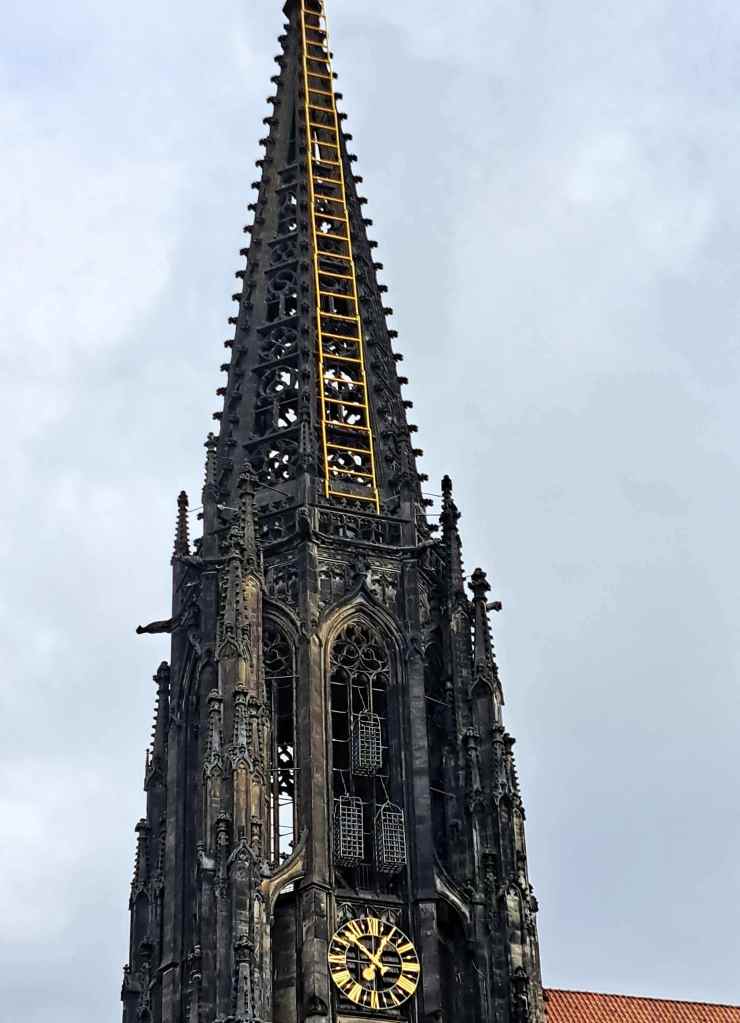
The rebellion in Münster was short-lived. The exiled Catholic bishop marshalled an army to besiege and recapture the city. Three of the Anabaptist leaders were tortured and the remnants of their mutilated bodies were placed in cages suspended from the tower of St. Lamberti church.
The cages remained there for centuries and were saved during the Allied bombing of Münster in the Second World War. When the church was rebuilt, cages were again placed on the church tower. They are still there.
Tourist gimmick or beneficial purpose?
I do not know if this is a tourist gimmick (they are famous as a photo op), or if they serve a more beneficial purpose. One source says that they remain “as a testament to an experiment in religious utopia, and the tremors they sent through German religious and political life for years after their occupants’ deaths.”
Another says they serve as a “reminder of religious intolerance and extremism.” Whose intolerance and extremism the source does not say.
In 1987, the church installed a yellow bulb in each cage to burn from dusk until dawn each night “in memory of their departed souls.”
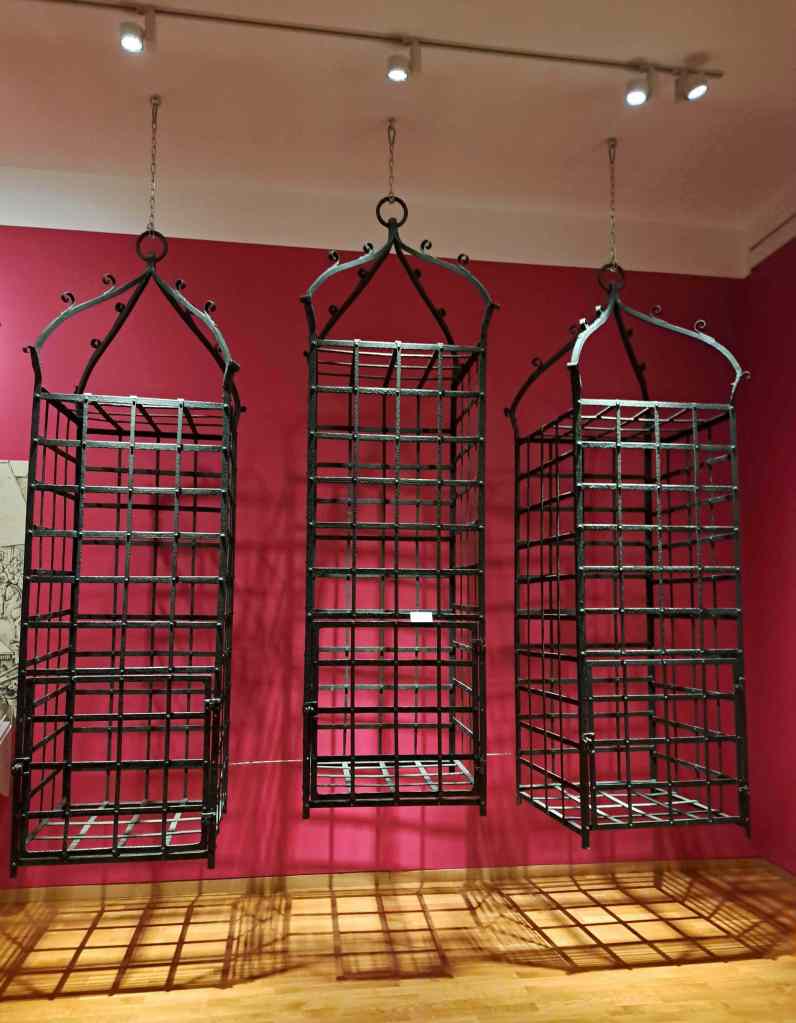
In Münster, we also visited the Stadtmuseum where we saw full-sized replicas of the metal cages. There is an entire room dedicated to portraying the revolt and its aftermath.
Blood is not destiny
Likely, I will never know whether my maternal Catholic ancestors had any brush with Anabaptists in those earlier, chaotic years. The Münster rebellion happened in the 1500s, and my grandmother was not born until 1878. There is so little that we know about the lives of our forebearers despite the popularity of genealogy.
On that note, the wonderfully talented Irish writer Fintan O’Toole begins one of his articles by writing, “Genealogy is fun, but it has never been an entirely innocent pastime.” In twentieth-century Germany, the Nazis turned ancestor research into a “murderous obsession.” Family histories, O’Toole writes, could be a licence for advancement if you were suitably Aryan, or a death warrant if you had Jewish ancestry.
O’Toole writes, in a less sinister note, that in America and elsewhere ancestor research has become “both a popular hobby and a literary genre.” He adds, “Even in these incomparably more benign forms, it retains the core idea that one is, in some crucial sense, defined by one’s ancestry.”
It is worth remembering that blood is not destiny. We are justly curious about our ancestors and the past, but they do not define us.
Discover more from Pulpit and Politics
Subscribe to get the latest posts sent to your email.


Hi Dennis,
Thanks for writing so compellingly, adding your own family history. Even today I shudder at how religious motivations have excused and forgiven barbarism. Of course, there are still examples of misplaced religious fervour leading to obscene and harmful acts today … your post helps us remember to oppose hate from any and all sources.
LikeLike
Thanks you Joe. It is always good to hear from you.
LikeLike